
How to Look Up Ada County Jail Population Data
Population data lives in published reports, not the live roster. The Sheriff's annual reports page publishes the broad operational numbers and program metrics. The FY25 Ada County budget book carries Jail Services Bureau funding levels and stated capacity. The Idaho Sheriffs' Association directory lists rated capacity. The U.S. Bureau of Justice Statistics jail reports and the Vera Institute county incarceration trends place Ada County in a state and national context.
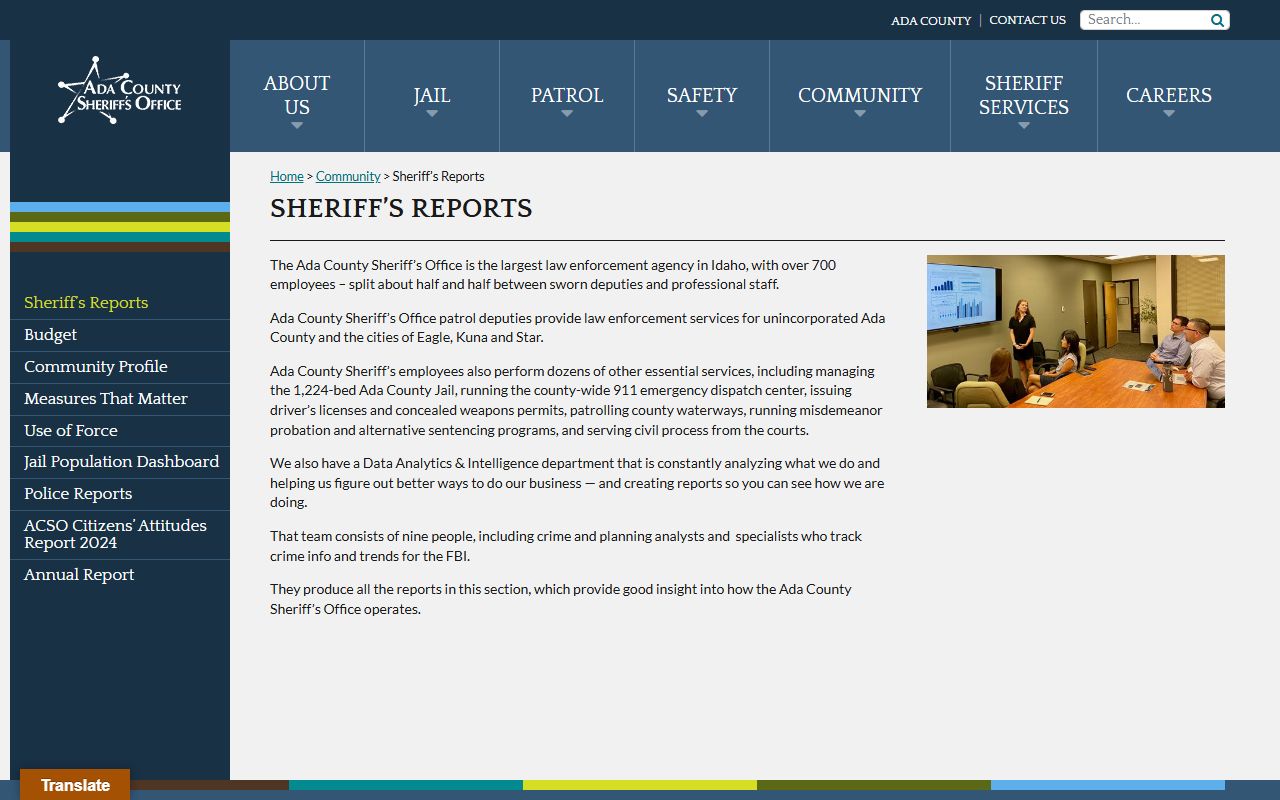
The Sheriff's reports page above provides the agency-level summary used by media and county budget hearings.
Ada County Jail Capacity Overview
Capacity figures vary by source. Each number is sourced to a specific official document. Do not merge them. The Sheriff's reports page lists 1,224 beds. The FY25 Ada County budget book lists capacity to hold 1,116 inmates. The Idaho Sheriffs' Association directory lists rated capacity 1049. The variation reflects different planning frames such as bed count, operational capacity, and state-rated capacity.
| Source | Capacity Figure | Frame |
|---|---|---|
| Ada County Sheriff's Reports page | 1,224 beds | Agency operational scale. |
| FY25 Ada County Budget Book | 1,116 inmates | Jail Services Bureau funded capacity. |
| Idaho Sheriffs' Association Directory | 1,049 rated capacity | State directory rating. |
The jail also operates a dedicated Maximum Security Unit with 44 cells. Three sections house Class One inmates, Class Two inmates, and higher-security cases.
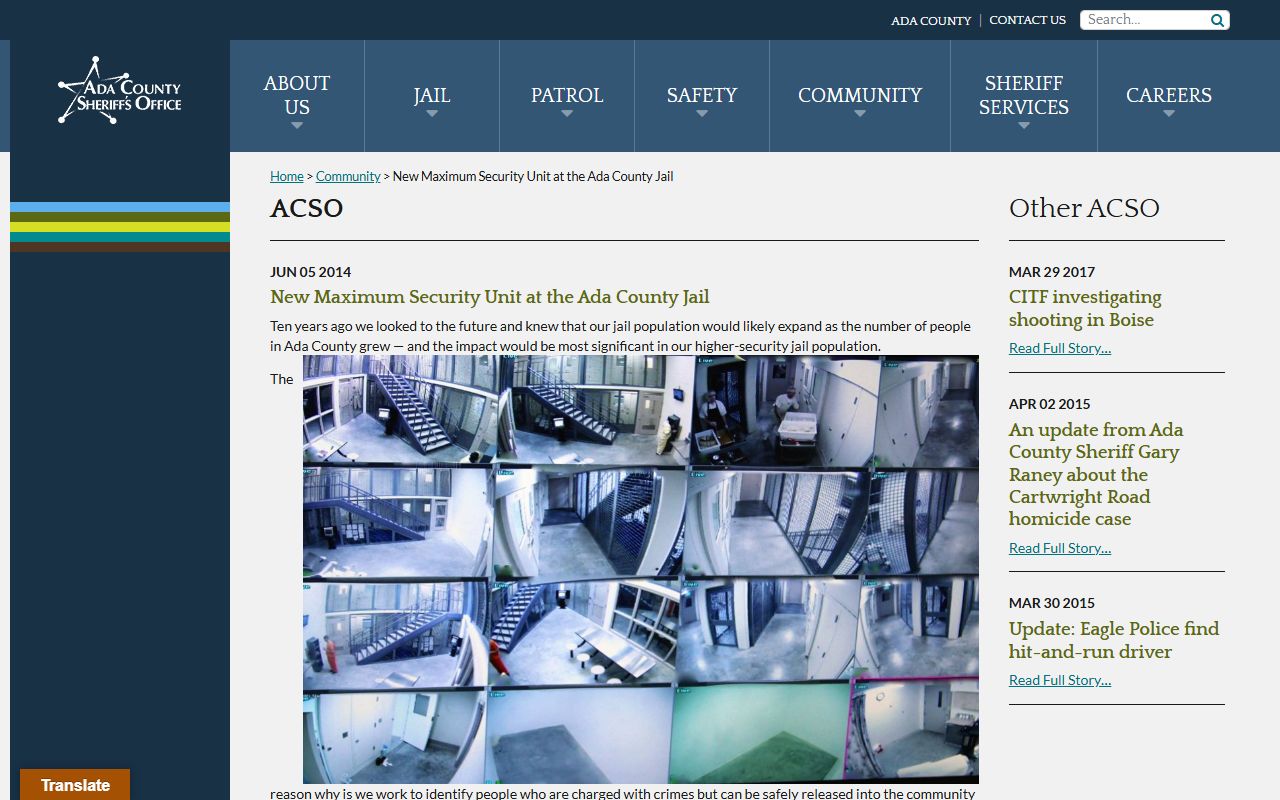
That post describes the $5.2 million Maximum Security Unit, its semicircular design, the three section split, the control room above the pod, two common areas, Telmate kiosks, and walk-throughs every 30 minutes.
Average Daily Population
Average daily population is the headline trend number jail planners use. Ada County's published average daily population sits in the Sheriff's annual reports. The exact figure varies by report year. The Sheriff's 2023 Annual Report references the population for that year. The page does not publish a live daily count alongside the roster. For an authoritative number for any given year, use the Sheriff's published annual report from that year.
Note: Capacity figures and average daily population are different measures. Capacity describes the building. Daily population describes how many people are inside on a given day.
Demographic Breakdown
Ada County publishes high-level operational data and program counts. A complete demographic breakdown by age, race, sex, and length of stay is not part of the public page text inspected. The published path for that data is the Sheriff's annual report and county budget book tables for the relevant year. National demographic context from the U.S. Bureau of Justice Statistics adds a comparison baseline for local figures.
Most Idaho jails report a younger adult population with a heavier male share, a smaller female share, and a smaller share of older adults. The state runs no central public dashboard that merges every county's jail demographics into one screen, so each county must be checked separately.
Pretrial vs Sentenced Population
The Ada County Jail holds two main populations under one roof. Pretrial detainees are held while their cases move through the District Court or Magistrate Division. Sentenced inmates serve county-level jail sentences after a conviction. Pretrial detainees keep their court status in iCourt. Sentenced inmates may also work through alternative sentencing under the Sheriff's misdemeanor probation program or the Community Transition Center.
| Pretrial | Sentenced | |
|---|---|---|
| Court Status | Case still open in iCourt. | Case closed with a judgment. |
| Release Route | Bond, ROR, conditions, or dismissal. | Time served, alternative sentencing, or transfer. |
| Programs | Limited program access during pretrial. | Eligible for in-custody programs and CTC if criteria are met. |
| Cost | Not assessed under Idaho Code 20-607. | $25 per day, up to $500 per incarceration. |
Misdemeanor vs Felony Population
Ada County's jail population includes both misdemeanor and felony inmates. Misdemeanor inmates often serve short sentences after a Magistrate Division ruling. Felony inmates may be held pretrial pending a District Court trial or sentencing. Some felony inmates are awaiting transport to the Idaho Department of Correction. Severity codes M and F on the current arrests page mark this distinction. The Sheriff's classification process places each inmate in the housing track that matches the risk and case profile.
Note: Sentence length is not the only factor in housing assignment. Behavior, medical needs, mental health, and prior record can all shift placement.
Mental Health and Medical Population
The jail runs an on-site medical unit staffed 24 hours a day, seven days a week, with full-time mental health providers. Higher-care medical housing serves inmates who cannot be in general population because of medical or mental-health needs. Emergency dental care is available. The health services page describes the unit's role in the broader operational model.
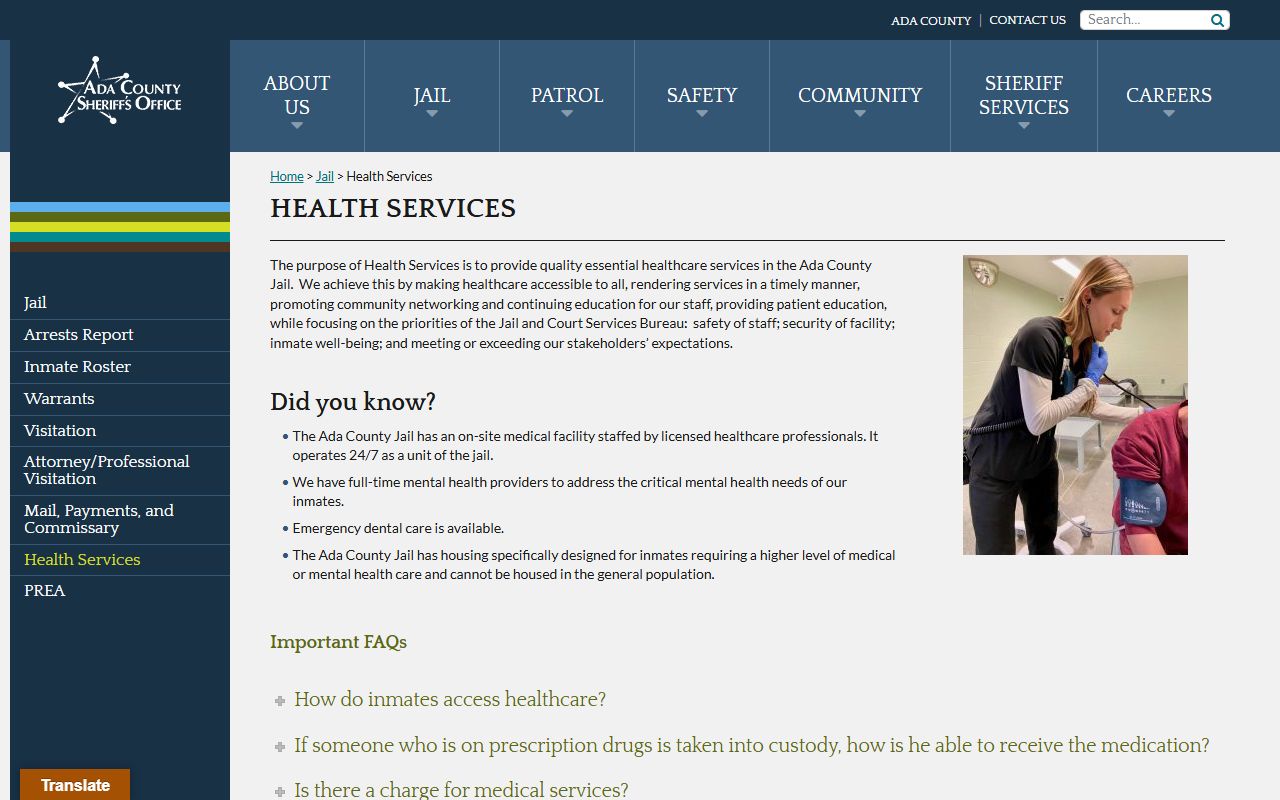
That page lays out the 24/7 staffing model and the housing track for higher-need inmates. The medical population overlaps with the general jail population but counts as a distinct planning category in budget documents.
National and State Context
The Bureau of Justice Statistics publishes the national jail data series, including national jail incarceration rates per 100,000 residents. The Vera Institute publishes county-level incarceration trends. Idaho's statewide jail population sits in a smaller range than larger states. Ada County's share of the state population pulls a meaningful share of the state's jail count. The Idaho Sheriffs' Association directory frames Ada County as the largest local jail.
Note: County jail rates and state prison rates are different measures. Jail rates describe local pretrial and short-sentence custody. Prison rates describe state and federal long-sentence custody.
Population Trends Over Time
Ada County's population has grown quickly. Census QuickFacts estimated 546,141 residents on July 1, 2025, a 10.3% increase from the 2020 base. Rapid county growth puts pressure on court calendars, jail bookings, and Sheriff staffing. Sheriff annual reports and county budget books repeatedly frame the jail as the largest in Idaho and discuss capacity expansion. Recent high-profile cases and population pressure have kept jail capacity and secure housing in public discussion.
For a multi-year trend table, the Sheriff's annual report from each year is the right source. Pulling several years of reports together gives a clearer picture than the single most recent number, especially during periods of rapid local growth.
Searching for Ada County Inmate Records by Name
Population data answers the "how many" question. Name searches answer the "who" question. For individual inmate lookups, use the Ada County inmate records page. The Sheriff's roster and the current arrests report handle current and recent custody. The Idaho Department of Correction Resident/Client Search handles state custody after sentencing. The Bureau of Prisons locator covers federal custody.
This page focuses on population data and trends rather than name lookups. The roster, the IDOC search, and the BOP locator are the right tools for finding a specific person.
Where Ada County Jail Data Comes From
Population data on this page traces back to a small set of official sources. The Sheriff's annual reports cover bookings, employee counts, calls for service, and operational scale. The FY25 Ada County budget book covers Jail Services Bureau capacity, treatment court support, and program funding. The Idaho Sheriffs' Association directory provides rated capacity. The U.S. Census QuickFacts page supplies the population denominator used for per-capita comparisons.
For statewide context, the Idaho Courts annual reports and the Bureau of Justice Statistics jail reports are the standard secondary references. Each number on this page should be matched back to a single source, not blended with other source numbers.
Alternative Sentencing and Population Pressure
Ada County uses alternative sentencing tools to control the sentenced share of the population. The Community Transition Center is the largest of those tools. CTC participants live in a less restrictive setting and continue to work, attend treatment, or complete required programs. The Sheriff's misdemeanor probation program adds another option for low-risk sentenced cases. Treatment courts in the Fourth Judicial District also redirect eligible cases away from custody and into supervised treatment.
Population pressure shows up in three places. Booking counts rise when more arrests come in from the Sheriff or partner agencies. Court calendar speed shapes how long pretrial detainees wait. Sentencing patterns shape how many sentenced inmates land in custody and for how long. Population planning runs through the budget book and the Sheriff's annual report cycle. Capital plans for new housing are reviewed through county board meetings.
Comparing Ada County Rates to State and National Numbers
A simple per-capita comparison can be helpful but must use matching definitions. The Bureau of Justice Statistics publishes the national jail incarceration rate per 100,000 residents. The Vera Institute publishes Idaho's state-level jail rate alongside county-level estimates. When comparing Ada County to either reference, use the Sheriff's published average daily population for the year and the Census QuickFacts estimate for the same year. Combining different years can produce misleading rates.
Note: Per-capita comparisons mask absolute differences between rural and urban counties, so use them as one signal rather than the only signal.
What Ada County Population Reports Do Not Publish Online
Several useful population figures are not part of the static text on the public pages. Exact average daily population by year, complete demographic breakdowns by age and race, pretrial-versus-sentenced ratios, average length of stay, and common-charge distribution sit in annual report PDFs and county budget tables rather than in standalone web pages. Anyone publishing a precise number should pull it from the source document and cite the year and report.
For statewide context that is published, the Idaho Sheriffs' Association directory and the Bureau of Justice Statistics jail series give the cleanest baseline figures available to the public.