
What Is an Ada County Court Docket
A docket is the official date-ordered list of events in a case. It logs every filing, hearing, order, and payment the court records. The docket is not the case file itself. A case file holds the full text of motions, briefs, exhibits, and orders. The docket points to those documents and records what the court has done so far. In Ada County, both the District Court and the Magistrate Division build dockets the same way through the iCourt case-management system.
The Ada County docket also serves as a public calendar. People who need to attend a hearing, watch a case, or confirm a postponement read the docket to see what is set and what has moved. Hearings appear with date, time, courtroom, and hearing type. Sealed events do not appear. Continued or rescheduled events show the new date once the clerk records the change.
How to Find Ada County Dockets Online
The official statewide portal is the Idaho iCourt Portal. The dashboard hosts Smart Search for case-level docket lookups and Search Hearings for a date-range calendar lookup. Hearing search runs on a specified date range. The portal recommends Edge or Firefox for the search workflow.
- Open mycourts.idaho.gov/odysseyportal and accept the legal notice.
- Choose Search Hearings for a calendar view or Smart Search for a specific case.
- Enter a date range, party name, case number, or location. Use Ada County or the Fourth Judicial District when the filter is available.
- Open a hearing entry or a case docket to read the events list. Look for date, hearing type, judicial officer, and courtroom.
Note: The Search Hearings tool runs by date range only and excludes sealed or restricted matters under ICAR 32.
Sample Ada County Docket Entry
Docket entries follow a uniform layout in iCourt. Every line carries an entry date, an event type, the party that filed or triggered the event, and a pointer to the related document or hearing. Many of those documents are not downloadable from the portal. Some link out only as docket text with the document at the courthouse kiosk or with the Clerk.
| Field | What It Shows |
|---|---|
| Entry Date | Date the event was recorded by the clerk. |
| Event Type | Filing, hearing, order, judgment, payment, warrant, or notice. |
| Party Filing | Party or court actor that triggered the event. |
| Document or Hearing | Reference to the underlying filing or scheduled hearing. |
| Hearing Date / Time | Date, time, and courtroom when the entry is a hearing. |
| Judicial Officer | Judge or magistrate assigned, when public. |
| Status | Pending, continued, completed, vacated, or sealed indicator. |
Courts That Publish Dockets in Ada County
Every Ada County trial court feeds the same iCourt docket system. District judges run general-jurisdiction calendars. Magistrate judges run misdemeanor, small claims, probate, eviction, and family law calendars. The administrative district judge supervises local calendars and assignments.
- District Court (Fourth Judicial District) — felony, civil over $10,000, appeals from magistrates.
- Magistrate Division — misdemeanors, infractions, small claims, probate, family, evictions, protection orders.
- Court Assistance Office — helps self-represented filers navigate the docket and e-file calendar requests.
- Idaho Court of Appeals and Supreme Court — publish their own appellate dockets separately on isc.idaho.gov.
The civil protection order workflow uses an online e-filing path that lands in the Magistrate Division docket once accepted.
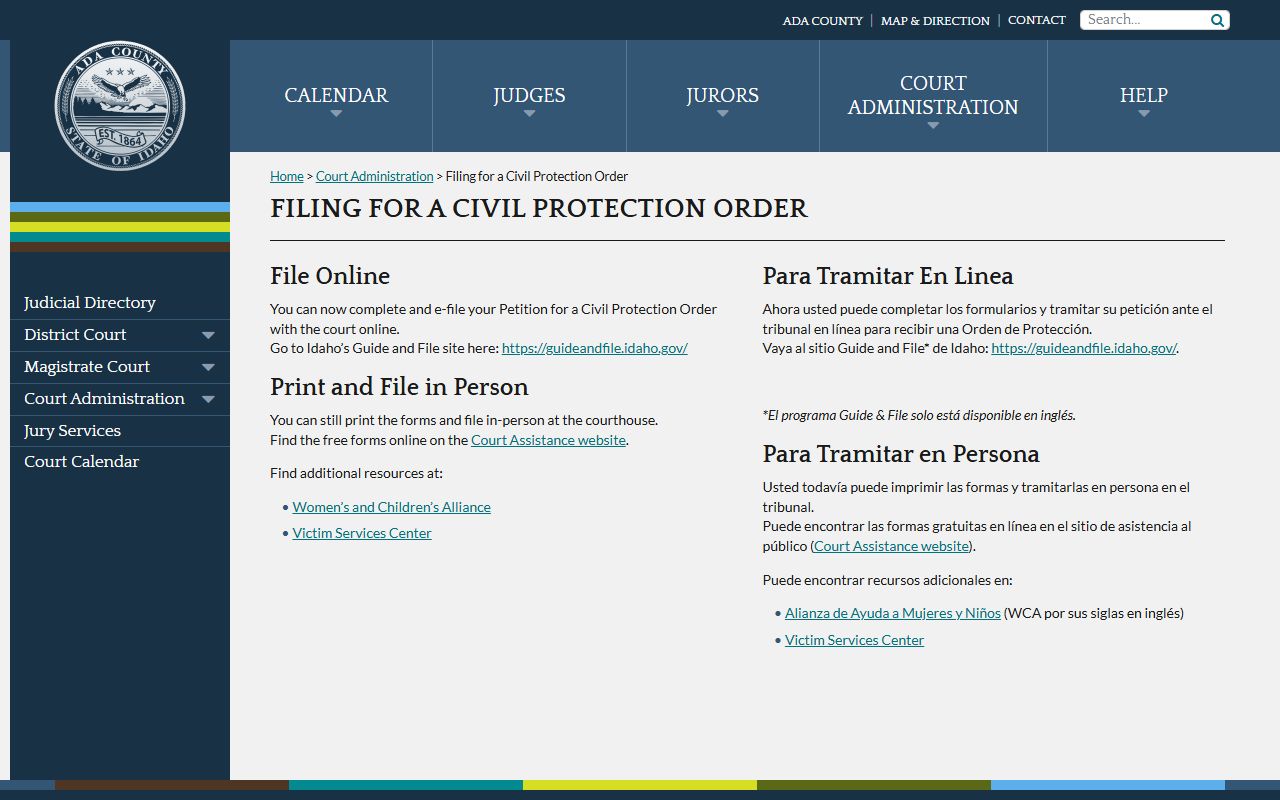
The page above shows the Idaho Guide & File option for civil protection orders. Once filed, the petition lands on the next available magistrate calendar and shows up as a hearing entry in iCourt.
Docket vs. Full Case Record
The docket is an event log. The case file is the full record. Both belong to the same case, but they answer different questions. The docket tells a reader what has happened and what is set. The case file tells a reader exactly what was filed, what the judge ordered, and what evidence was attached. Bank and title companies often need full case documents, not just docket entries.
| Docket | Full Case Record | |
|---|---|---|
| Format | Date-ordered list of events. | Full pleadings, motions, exhibits, orders, transcripts. |
| Access | Often online and free in iCourt. | Kiosk visit, Clerk request, or certified copy fee. |
| Use | Track case progress and next hearing. | Legal review, evidence, certified proof for banks and other courts. |
| Sealed material | Sealed events do not appear. | Sealed documents stay restricted under ICAR 32. |
Cameras, Hearings, and Public Attendance
Idaho courts are presumptively open. People can attend most hearings without an appointment. Photography, recording, and broadcast coverage need advance approval from the presiding judge under Idaho Court Administrative Rule 45.
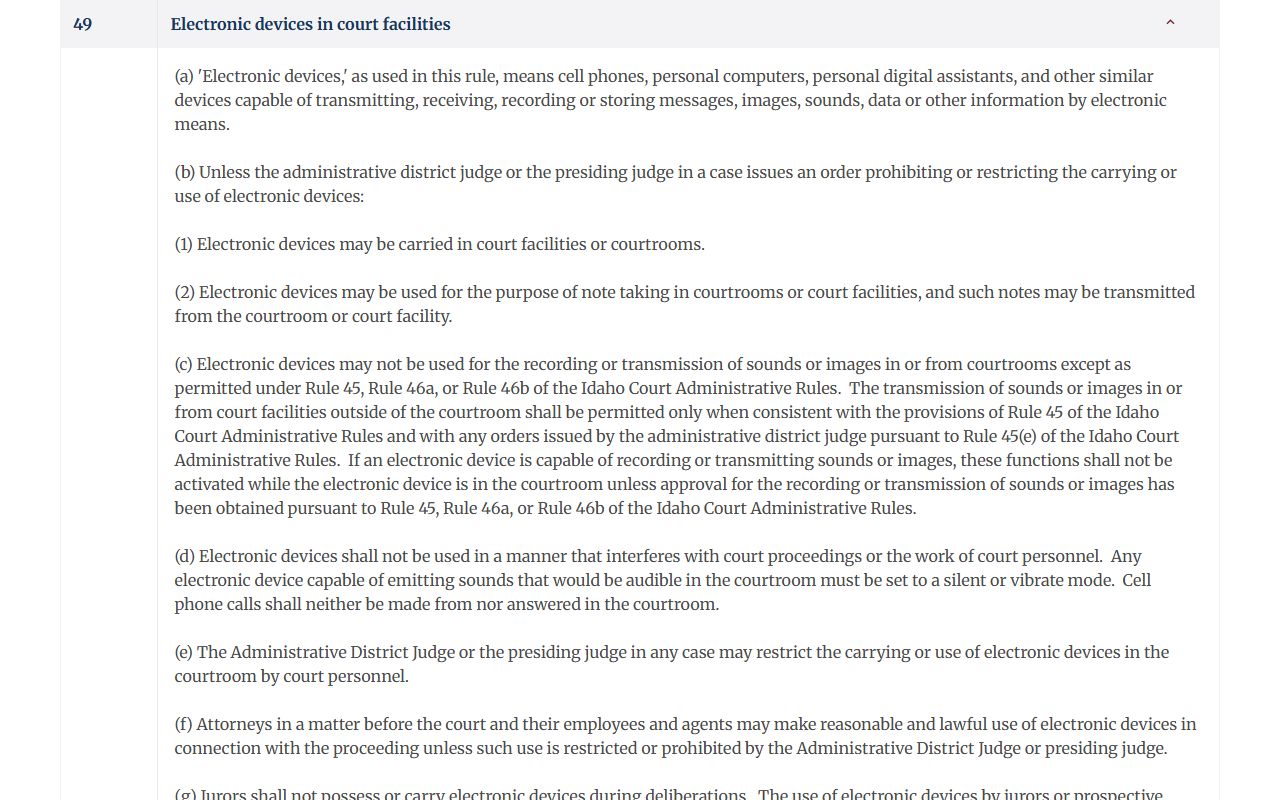
The page above sets the camera-coverage rule that controls press and public recording in Ada County hearings. Some proceedings are closed by rule. Adoption, mental health, child protective, termination of parental rights, grand jury work, and certain warrant proceedings are off-limits to cameras and are not part of the public docket display.
How to Read an Ada County Docket
Docket entries use short labels that condense long phrases. A reader who knows the shorthand can scan a case in a minute. CR is criminal. CV is civil. PR is probate. FTA stands for failure to appear. OSC means order to show cause. NCO is a no-contact order. A hearing entry tagged "vacated" was set and later cancelled. A line tagged "judgment entered" closes a charge or claim with a final order.
Disposition codes carry a lot of weight. Guilty on a charge line is a conviction. Dismissed with prejudice means the charge cannot be refiled. Dismissed without prejudice means the prosecutor may refile within the limitations period. A civil case may end in judgment for plaintiff, judgment for defendant, dismissed, or settled and dismissed. Probate dockets often close with a closing statement or a final accounting.
Criminal Hearing Types on Ada County Dockets
Criminal dockets in Ada County follow a familiar sequence. Each stage is a separate hearing entry on the docket. The arrest and booking step lives with the Sheriff and shows up later in the court file once the prosecutor files a complaint or information.
- Initial appearance — first court date after arrest. The court reads the charge, advises rights, and sets bond conditions.
- Preliminary hearing — felony probable cause review in front of a magistrate judge.
- Arraignment — entry of plea before the district or magistrate judge.
- Pretrial conference — status and settlement discussions before trial.
- Trial — jury or bench trial scheduled by the assigned court.
- Sentencing — entry of judgment after conviction or plea.
- Review and probation hearings — check-in dates after sentencing or under treatment court supervision.
Hearings can be continued, vacated, or reset. Each change shows up as a separate docket line so the history stays visible.
Civil and Probate Events on the Docket
Civil dockets follow a different rhythm than criminal cases. A complaint or petition opens the docket. A summons is issued. The defendant or respondent files an answer or a motion. The judge sets a scheduling order. Hearings, discovery deadlines, and motions appear in order. The case ends with a judgment, a dismissal, or a settlement entry.
Probate dockets in Ada County are handled in the Magistrate Division. The opening event is the petition to admit a will, appoint a personal representative, or open a guardianship or conservatorship. Notice to creditors, inventories, and accountings follow. The closing entry is the final report or closing statement. Some probate dockets remain open for years when long-term care for a protected adult or minor is involved.
Court Date Changes and Continuances
Hearings move often. A judge may continue a hearing because a party is unavailable, because counsel needs more time, or because the court calendar is full. Continuances are added to the docket as separate entries that show both the original date and the new date. Vacated hearings also stay on the docket so the full procedural history is preserved.
Note: A new hearing date may not appear in iCourt the same hour the judge signs the order. Allow time for the clerk's office to record the change, especially late in the day.
Sealed Events in Ada County Dockets
Some entries never reach the public docket. ICAR 32 directs the iCourt portal to hide sealed cases and sealed event entries from general public view. A reader will not see a placeholder where a sealed event would have been. The line is simply not there. Orders that authorize a seal may still appear in the public record so that the existence of the sealing decision is documented.
Juvenile, adoption, mental health, and child protective dockets are restricted entirely. Search warrant affidavits are not part of the public docket until the warrant is returned and the file is unsealed by rule. Parties, counsel of record, court staff, prosecutors, and law-enforcement officers acting within official duties may have access where the rule allows. The general public does not.